

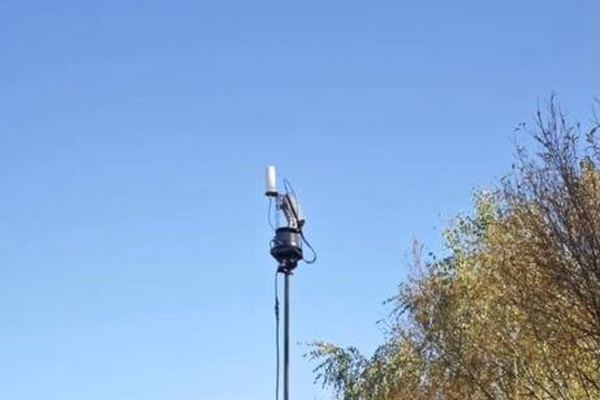
Ukrainian defence developer December1 has unveiled a radio-frequency scanner that does something few counter-drone systems attempt: it does not only find drones, it lets operators watch what the drone itself sees. The DroneSensor Providence, shown at the IRON HALLOWEEN PARTY 2026 event, scans the 600 to 8,500 MHz band, tracks drone communication channels out to 30 kilometres, and pulls live video from FPV drones while they are still in the air.
Seeing the enemy’s own video feed
Providence works by automatically monitoring the radio spectrum and identifying the type of each signal it finds. It covers analogue video channels, including inverted signals, digital systems such as Walksnail, and the mesh networks used by Russian attack drones such as the Geran. By intercepting a live analogue FPV video feed, an operator can watch the camera transmission of an incoming aircraft and work out its flight path before it arrives.
In crowded airspace the system separates overlapping signals and sorts them into categories. Craft-name identification lets it tell a friendly drone from a hostile one at once, which matters when both sides are flying similar aircraft over the same ground. Intercepted telemetry and video can be sent to a local web interface, or streamed into Ukraine’s military platforms: Vezha, which carries live drone video, and DELTA, the Defence Ministry’s battlefield situational awareness system.
From detection straight to jamming
Providence was designed as part of a wider counter-drone architecture, not as a standalone gadget. It pairs directly with December1’s Damba electronic warfare system. Once Providence detects and classifies an aerial threat, it routes the target data straight to the jamming hardware, which disrupts the enemy drone’s control link. No third-party integration components are needed between the two.
Built for the field
The scanner sits on a motorised platform that gives it full 360-degree coverage, and it supports remote operation and over-the-air software updates. Continuous firmware updates let technicians expand the system’s signature library as new enemy radio communication standards appear on the battlefield, so the unit keeps up with changing drone links.
Providence supports fixed, tactical and mobile deployments. At fixed sites it watches the airspace around critical infrastructure, supply hubs and energy facilities. Near the front line it tracks incoming FPV strike paths and locates ground control stations. Mounted on military vehicles or armour with omnidirectional antennas, it protects mobile operations on the move.
Tested at the front
Frontline units tested the system in the Donetsk, Zaporizhzhia and Sumy directions. During one operational test, the scanner picked up an incoming FPV drone together with its ground command station, allowing Ukrainian forces to locate the enemy position and hit it.
Production is already running at scale. December1 makes hundreds of units a month to support Ukrainian forces, and plans to scale manufacturing into the thousands per month by 2027.
Why it matters
Providence points to where drone detection is heading: from simply warning that a drone is nearby, to showing operators exactly what the drone sees and where it is controlled from. Video interception turns a detector into a targeting aid, craft-name identification cuts the risk of engaging friendly aircraft, and a direct feed into jamming hardware shortens the chain between spotting a threat and stopping it. Watching live FPV video feeds is the same detection capability RF Apex builds into the DW01 handheld detector. As FPV drones become the standard strike weapon, scanners that can read their video links are becoming standard kit.
Source: UNITED24 Media