

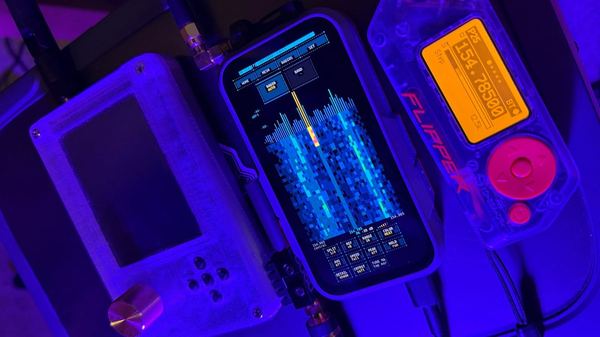
An open-source project called LakeShark has turned a small ESP32-P4 development board into a self-contained handheld radio-frequency scanner. The device needs no laptop, no phone and no external radio. It samples the spectrum, computes the fast Fourier transform and draws the result on its own touchscreen. Firmware, source code, hardware files and build instructions are all published on GitHub, so anyone can build one or adapt the design. It is the latest sign of how far pocket spectrum scanning has come, a capability that once needed a bench full of equipment and now fits in a jacket pocket.
A scanner that does the maths itself
The heart of the device is the ESP32-P4, a microcontroller with two RISC-V cores. The chip runs the FFT in real time on the board itself, turning raw radio samples into a spectrum display without any help from a computer. That matters because it removes the usual weak point of portable scanning, the link to a host machine. There is no USB cable to snag, no driver to install and no laptop battery to watch. The scanner is a single self-contained unit, and the signal processing happens where the signal is received. For field work, that independence is the whole point.
A touchscreen that keeps up
Results appear on a capacitive touchscreen connected over MIPI-DSI, the same kind of fast display interface used in phones and tablets. The screen shows a live waterfall, a spectrum plot and signal strength, and it keeps up with the incoming data without dropping frames. Touch menus put the main controls at the operator’s fingertips: centre frequency, gain, bandwidth and the way the data is visualised. Changing a setting is a tap rather than a command line, which makes the device usable with one hand and no manual.
Bands and radios
LakeShark works in the sub-gigahertz bands, covering the industrial, amateur and aviation spectrum that field engineers most often need to check. It also supports LoRa radio modules, including the SX1262 and the LR2021, which opens up wireless telemetry work alongside plain spectrum observation. The combination covers two common field jobs at once: looking at what is on the air, and talking to the low-power devices that live there.
Built for field work
The device is built for life outside the lab. It boots quickly, draws little power and runs from an internal lithium-polymer battery, so it can be carried in a pocket and switched on only when needed. Field engineers can use it for local spectrum scans, for hunting down sources of interference and for checking wireless telemetry links on site. A tool that is always at hand gets used, while a tool that needs setup often stays in the bag.
Why it matters
Handheld spectrum scanning is moving steadily towards standalone devices, and LakeShark shows how far open hardware has pushed the idea. Knowing what is on the air is the first step in any radio-frequency job, and for drone detection and counter-drone work it is the step everything else depends on: you cannot track, identify or jam a signal you have not first seen. Cheap, pocketable scanners put that first step in more hands, and they make the radio spectrum a little less of a mystery for the people who have to work in it.
Source: Open Source For You