

Airports are among the most security-sensitive environments in the world. Yet in recent years, one of the most persistent and disruptive threats has not come from the ground — it has come from the sky. Unauthorized drones near airports have caused runway closures, flight cancellations, and serious safety incidents across multiple continents. As this threat grows, airport security teams and aviation authorities are actively seeking effective counter-UAS (Unmanned Aircraft System) solutions.
But with dozens of products on the market and significant variation in capability, range, and deployment method, choosing the right system is not straightforward. This guide is designed for security directors, procurement officials, and defense integrators who need a clear, practical framework for evaluating counter-drone technology in an airport environment.
Commercial airports present a unique vulnerability profile. Their perimeters are large and difficult to monitor continuously. Their airspace is tightly controlled but extends in three dimensions. And the consequences of a drone incursion — even an accidental one — can be severe.
Some of the most documented airport drone incidents include:
These incidents make clear that airport drone threats are not hypothetical. They are an operational reality, and the cost of unpreparedness — in disruption, liability, and reputational damage — is substantial.
Before comparing specific products or technologies, it is essential to understand that effective airport counter-UAS protection requires two distinct capabilities working together:
You cannot respond to a threat you have not identified. Detection systems monitor the airspace continuously and alert operators when an unauthorized drone enters a defined zone. Key detection technologies include:
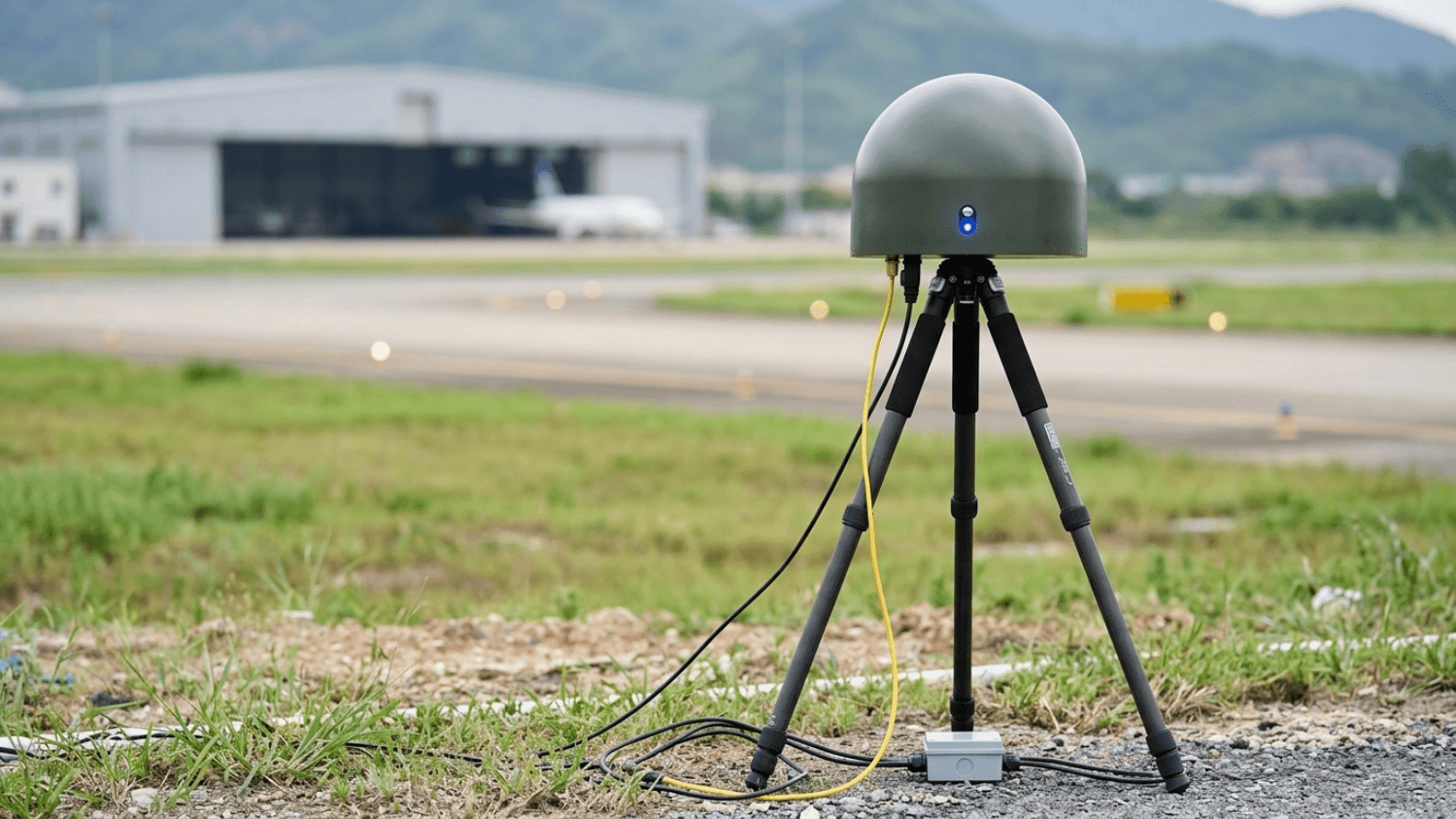
For most airport environments, RF-based detection combined with optical verification provides the most reliable and cost-effective solution. Systems like the RFApex N2 Drone Detection System are designed specifically for this role — scanning across multiple frequency bands simultaneously and providing real-time alerts with directional information, so operators know not just that a drone is present, but where it is coming from.
Once a drone is detected and confirmed as a threat, the security team needs a reliable method to bring it under control. In airport environments, the neutralization method must be carefully chosen to avoid creating additional hazards. Physical interception (nets, trained birds) is impractical at scale. The most widely adopted approach for airports is RF signal disruption — commonly referred to as jamming.
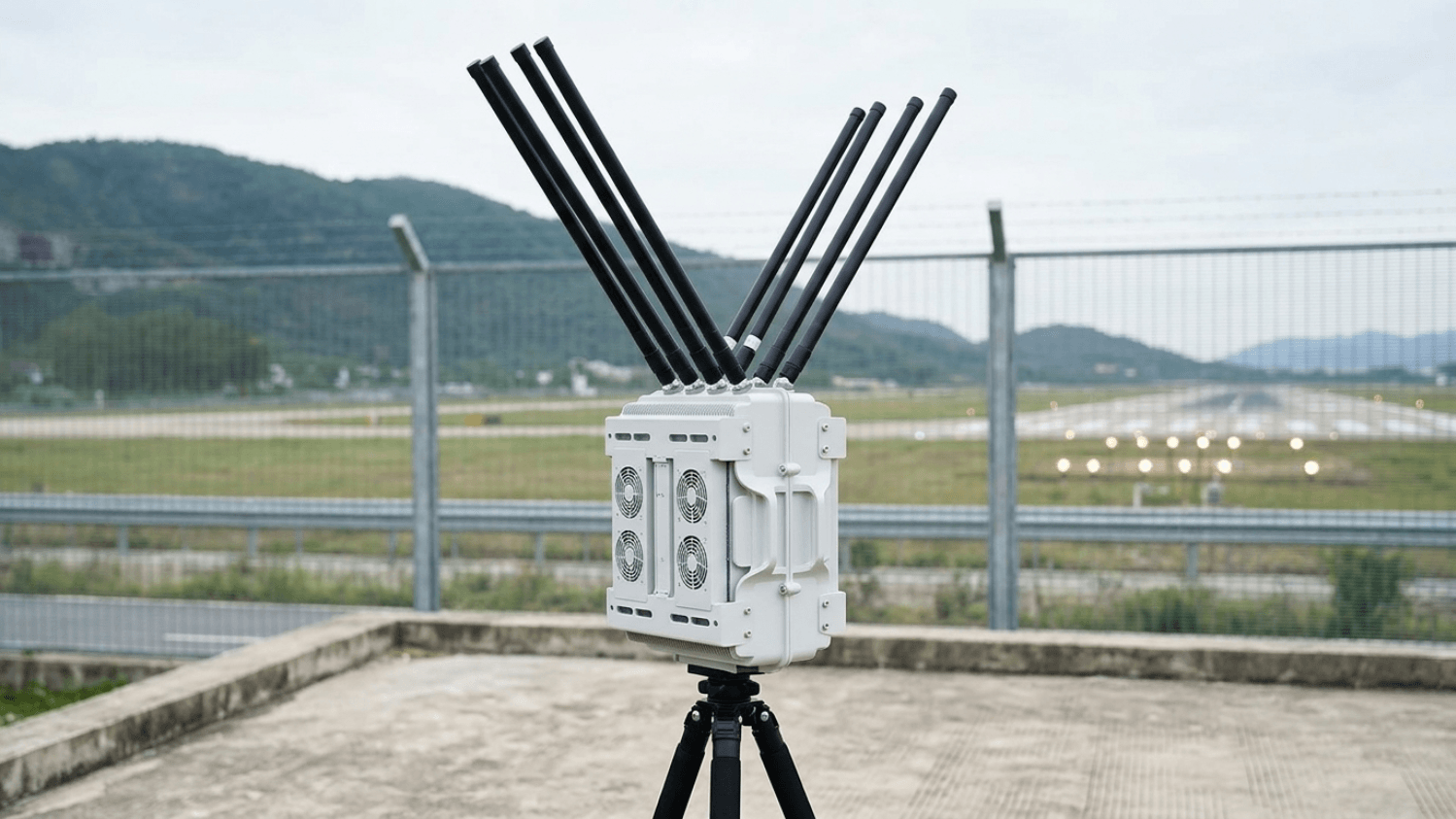
RF-based neutralization works by transmitting a powerful signal on the same frequency bands the drone uses for communication and GPS navigation. The drone loses contact with its operator and, depending on its programming, will typically:
None of these outcomes involve a crash or projectile, which is critical in an airside environment where debris on runways is itself a serious hazard.
When comparing systems for airport deployment, security procurement teams should evaluate the following factors:
Airport perimeters vary significantly in size. A small regional airport may require coverage of 2–3 kilometers of runway and approach paths. A major international hub may need to protect 10+ square kilometers of controlled airspace.
Match the system's rated detection and neutralization range to your actual perimeter requirements. Do not rely solely on manufacturer specifications — request documentation of real-world test performance.
Modern commercial drones operate across a growing range of frequency bands: 433 MHz, 900 MHz, 2.4 GHz, and 5.8 GHz for control signals, plus GPS L1 (1.575 GHz) and GPS L2 (1.2276 GHz) for navigation. A system that only covers one or two bands will fail against drones using alternative frequencies.
Effective airport-grade solutions must cover all major drone communication and GPS bands simultaneously.
Airport security requirements vary by zone and operational scenario:
| Scenario | Recommended Deployment |
|---|---|
| Continuous perimeter monitoring | Fixed installation with integrated detection array |
| Rapid response to incursion alerts | Portable or vehicle-mounted neutralization unit |
| VIP aircraft protection | Handheld locator + portable jammer combination |
| Construction or temporary events | Backpack-mounted portable systems |
A well-designed airport counter-UAS program typically combines fixed infrastructure for constant monitoring with portable units for flexible response. Backpack-mounted systems such as the RFApex M6/M7/M8 series allow security personnel to respond quickly to any point along the perimeter without relying on fixed infrastructure alone.
Advanced counter-UAS systems are only effective if the operators can use them correctly under pressure. Evaluate the complexity of the system's interface and the training burden it places on your team. Systems with intuitive controls and clear visual displays reduce response time in real incidents.
This point cannot be overstated: the use of RF-disruption equipment is regulated in every jurisdiction. Airport security teams must ensure that any counter-UAS system they deploy has been approved for use by the relevant civil aviation authority and telecommunications regulator in their country.
RFApex works with procurement teams to provide the necessary technical documentation to support regulatory approval processes in target markets.
Based on common airport security requirements, the following tiered approach is recommended:
Tier 1 — Continuous Perimeter Detection
Deploy a fixed RF detection system (such as the N2 series) at key points along the airport boundary. Configure alert zones that trigger automatic notifications to the security operations center.
Tier 2 — Rapid Mobile Response
Equip at least two security response teams with portable backpack jammers (M or L series, depending on required range). These teams can be deployed quickly to any point where a threat is detected.
Tier 3 — Handheld Locator for Ground-Level Search
Provide ground security personnel with handheld drone locators (H2L series) for close-range threat identification and operator location tracking. This is particularly useful for identifying where an unauthorized drone operator is physically located.
This three-tier structure ensures that detection and neutralization capabilities are present at every level of the airport's security operation.
Before committing to a procurement decision, security directors should ask potential suppliers the following:
A supplier that cannot provide clear, documented answers to these questions is not ready to support an airport-scale deployment.
Airports face a drone threat that is growing in frequency, sophistication, and potential impact. Choosing the right counter-UAS system is not simply a matter of selecting the most powerful available option — it requires a structured evaluation of detection capability, neutralization method, deployment flexibility, and regulatory compliance.
The most effective airport security programs combine multiple layers: fixed detection infrastructure, mobile response units, and handheld tools for ground-level operations. Ensuring all three layers are covered gives security teams the situational awareness and response capability needed to handle unauthorized drone incursions quickly and safely.
RFApex provides integrated counter-UAS solutions designed to meet these requirements across a range of deployment scales, from regional airports to major international aviation hubs.
Looking for a tailored counter-UAS solution for your airport or aviation facility? Contact our team to discuss your specific requirements and receive a customized system recommendation.
Talk to our team — we'll recommend the right system for your deployment scenario.