

The United States military says it has defeated more than 300 drones along the southern border this year. The claim comes from U.S. Northern Command, which runs the Joint Task Force-Southern Border, the joint task force that operates on the southern border. But the public record behind the number is thin: only two of those engagements have ever been identified in public, and both of them turned out to be something other than a hostile drone. The gap between the headline figure and the evidence behind it is now the story — and it is drawing questions from Congress, from aviation regulators, and from anyone who has to judge whether a counter-drone claim can be trusted.
U.S. Northern Command put the figure out on September 4. It said Joint Task Force-Southern Border had defeated more than 300 drones in 2026, with more than 100 of them brought down in August alone. Eleven of those, the command said, were shot down with a laser: the AMP-HEL, a 20-kilowatt directed-energy weapon mounted on an Infantry Squad Vehicle. The system is one of the military’s newest tools for drone mitigation — a beam of light instead of a bullet, aimed at small, low, slow targets that are hard to hit any other way.
The laser has been busy on the border. On November 2, soldiers from the 101st Airborne Division trained with the AMP-HEL near Fort Hancock, Texas, rehearsing how to detect, track and engage drones crossing from Mexico. The training was public, with photographs of the turret mounted on the vehicle and soldiers working the controls. It was the kind of demonstration that makes a new capability look real — and it came two months after the command first announced the 300-drone figure.
For all the size of the claim, only two border drone engagements have ever been described in public, and neither one fits the picture of a hostile drone being shot down.
The first happened on February 10, near Fort Bliss in Texas. A Customs and Border Protection laser, the LOCUST system, fired on what turned out to be a cluster of Mylar party balloons. The Federal Aviation Administration shut down the airspace over El Paso for eight hours while the incident played out, and 14 flights were cancelled. A party decoration had closed a civilian airport.
The second happened on February 26, over Fort Hancock. The military destroyed a drone — and then found out it belonged to Customs and Border Protection. The agency had been flying it without telling the military it was there. The military shot down a friendly aircraft because nobody had shared the flight plan.
Those are the only two engagements the public has been told about in any detail. Everything else behind the figure of 300 sits in classified or internal reporting that has not been released.
The most detailed public numbers came on September 29, from Maj. Gen. Curtis Taylor, the commander of the border task force. He told reporters that between August 22 and September 22, the military had detected 378 drones. Of those, 75 were turned back, 15 were engaged, and one was captured. The rest, he said, were mostly reconnaissance flights — between 95 and 98 percent of the drones detected were scouting for human smuggling operations, not carrying weapons or drugs.
That picture is more complicated than a simple scoreboard. Detection is not the same as defeat, and most of what crosses the border is being watched rather than shot at. The general’s numbers describe a surveillance problem as much as a shooting problem — hundreds of small aircraft, most of them gathering information, in airspace shared with civilian traffic and with other government agencies flying their own drones. It also raises a basic question about the 300 figure: if only 15 drones were engaged in a month when 378 were detected, what does “defeated” mean for the other 285? The command has not explained the term.
Congress noticed the gap. On March 13, Senator Tammy Duckworth asked three inspectors general — at the Department of War, the Department of Homeland Security and the Department of Transportation — to investigate the border drone operations. Eight months later, nothing from those inquiries has been made public.
The regulatory picture has moved faster than the accounting. On April 10, the FAA cleared the military to use lasers in American airspace, removing one of the legal obstacles to shooting down drones over the border. And on October 20, the FAA issued three notices banning drone flights within one nautical mile of the border, in force until October 19, 2027 — an acknowledgement that the airspace there is now a military operating area as much as a civilian one.
For anyone buying or building counter-drone systems, the border story is a warning about numbers. A claim of 300 defeats sounds decisive, but a buyer who cannot see what was defeated, with what, and under whose authority is being asked to trust the scoreboard rather than the evidence. Drone detection and drone mitigation are only as good as the record behind them — and in this case, the record the public can check contains a balloon and a friendly drone. The technology is real, and the laser works. The accounting is what still needs to be proved.
Source: DroneXL
Ukrainian drone maker Warbirds has upgraded two of its reconnaissance drones, Soika and Halka, to keep flying when the enemy is trying to jam them — and to keep navigating when satellite signals are gone. The changes are a direct answer to the electronic warfare fight over the front line, where the side that can still see and still steer wins. Both aircraft now carry new antennas, new navigation and better sensors, and both are built to finish their missions even if their link to the operator goes dead.
Halka’s upgrade starts with its antennas. The drone now carries wideband antennas that can work across a broad range of frequencies, and its radio link hops between frequencies in a pseudo-random pattern. That makes the aircraft much harder to jam: an electronic warfare station has to cover the whole band at once, instead of sitting on a single frequency and waiting. In one three-hour frontline flight, Halka went about 20 seconds without telemetry — a short gap in a long mission, and a sign of how well the link holds up under interference. For a reconnaissance drone, those seconds matter: every gap is a moment when the operator cannot see what the aircraft sees.
Soika takes a different approach to the same problem. Its antennas are interchangeable, and the crew fits the right antenna for the band they expect to use before takeoff. If the control channel is suppressed in flight, Soika does not need the operator to bring it home: it can fly its mission and return on its own, carrying back the photographs and data it collected. That kind of autonomy changes the calculation for electronic warfare. Jamming the link no longer guarantees the drone is lost — it just means the drone is flying without supervision until it comes back.
Both aircraft are also learning to navigate without satellite signals. Soika and the Halka Mk2 and Mk3 now use radio-beacon navigation, fixing their position from ground-based beacons instead of GPS. They back that up with odometry and visual navigation, measuring their own movement and reading the ground below them. It is a layered answer to satellite jamming: no single source of position is trusted on its own, and the aircraft can keep its bearings when the sky goes quiet. In a war where GPS is jammed almost everywhere it matters, that is no longer a luxury — it is a requirement for any reconnaissance drone that expects to come home.
Warbirds is still working on both aircraft. Soika and the Halka Mk2 are moving to full-frame sensors for better imagery, and the Halka Mk3 is getting better optics and zoom. The company is also testing ways to detect when a drone is being intercepted, watching for signs in the optical, acoustic and radio-frequency spectra. The plans are straightforward: longer range, better photographs and video, and more automated flights — and a new long-range FPV drone, the DZYGA-17S, is already in trials, with two units flying.
The Warbirds upgrades show which way the contest is moving. Jamming is getting stronger, so drones are getting better at dodging it — hopping frequencies, swapping antennas, navigating without satellites. For counter-drone work, that means detection and jamming have to cover wider bands and more kinds of signals than before, because the aircraft on the other side are built to survive exactly that.
Source: LB.ua
Motorola Solutions has closed its $1.3 billion acquisition of D-Fend Solutions, adding drone detection and cyber takeover to a portfolio built around mission-critical communications. The deal, completed net of cash, puts a counter-drone capability inside the same company that supplies the radios, video systems and command centres used by police and emergency services around the world. For Motorola, it is a bet that the next piece of public-safety infrastructure is the ability to see a drone — and to take it over rather than shoot it down.
D-Fend’s system detects drones and then takes control of them through their own radio links — a cyber takeover, not a kinetic kill. The drone is landed or steered away without being destroyed, which matters in cities and around airports, where debris from a shot-down aircraft can be as dangerous as the drone itself. Motorola will fold the technology into its mission-critical networks, alongside its land mobile radio business and its Silvus Technologies unit, the mesh-networking company it also acquired to build out its communications portfolio. The company expects D-Fend to contribute about $45 million in revenue for the rest of the year — a small number against Motorola’s scale, but a foothold in a market that is growing fast, and one that now sits inside the company’s core offer rather than outside it.
The fit is with Motorola’s public-safety customers. A police department or an airport already buys radios, cameras and command-centre software from the same supplier; adding drone mitigation to that stack means the detection feed can land on the same screens operators already watch. Takeover, rather than jamming or shooting, is the piece that suits sensitive sites best: it ends the threat without dropping debris on a crowd or a runway. That is the capability Motorola is now selling as part of its core offer, not as an add-on from a third party — and it is the option a growing number of cities and airports are asking for first, because it is the one that works where a kinetic answer is not allowed.
The acquisition closed in a strong quarter. Motorola’s Products and Systems Integration sales rose 12 percent, and Software and Services grew 13 percent. Orders were up more than 20 percent year over year, and the order backlog reached a record $16.6 billion — a sign that demand across the business is outrunning supply. The quarter also brought a $56 million fixed-video order from a convenience store chain, a $139 million ten-year contract in Louisiana, a $51 million command centre for the Los Angeles Police Department, and a $78 million eight-year federal mobile video deal. Motorola raised its full-year revenue forecast to about $13.05 billion. The D-Fend deal is a small part of that total, but it is the part that opens a new market — and it arrives at a moment when the rest of the business is already running at record levels.
The Motorola deal is a sign of where the counter-drone market is heading: consolidation. Detection and mitigation are moving inside the big public-safety platforms, next to radios and video, instead of living as standalone boxes. And takeover is emerging as the mitigation method of choice for cities and airports — quiet, controlled, and free of falling debris. Expect more of the same as other platform vendors look for their own drone capability, because the customers are now asking for counter-UAS as part of the system they already buy, not as a separate purchase.
Source: SecurityInfoWatch
Russian Shahed drones flying over Kyiv are now carrying 32-element Kometa antenna arrays — the largest version yet of a satellite-navigation receiver built to survive Ukrainian jamming. The arrays are made by VNIIR-Progress, and they are the latest step in an arms race measured in antenna elements: each new version can suppress more jamming sources at once, and each one forces Ukraine to find a new answer. More than 100,000 Kometa modules have been ordered this year, and they are going into drones, missiles and guided bombs alike.
A Kometa module is a patch-antenna array: a flat grid of small antenna elements that work together to receive satellite navigation signals while rejecting interference from other directions. The more elements in the grid, the more jamming sources it can cancel — each element gives the receiver another degree of freedom to steer a null toward an incoming jammer. Ukraine first faced 16-element arrays, fielded at scale. Then came 20-element versions, now in serial production. The 32-element array found on a Shahed over Kyiv is the biggest yet — and it was assembled from two 16-element arrays, each tuned to a different satellite-navigation band. The production numbers show how seriously Russia takes the design: more than 100,000 modules ordered in 2026, for drones, missiles and guided bombs.
Kometa is not only a drone component. Ukrainian military intelligence lists the module in Geran drones — the Russian name for the Shahed — and in glide-bomb kits, the Iskander-M ballistic missile, the Kinzhal hypersonic missile and the Filin cruise missile. That spread is the point: one navigation receiver, hardened against jamming, can be fitted to almost anything that flies and needs to know where it is. For Ukraine’s electronic warfare units, that means the same countermeasure problem appears across the whole Russian arsenal, not just in one weapon — and every new platform that carries Kometa extends the problem a little further.
Serhii Beskrestnov, known by the call sign Flash and an adviser to President Zelenskyy, put the problem plainly: more elements means more electronic warfare sources suppressed at once. He added that it is easier for Russia to add antenna elements than it is for Ukraine to add electronic warfare sites. Each new jamming station takes time, money, power and a crew; each new antenna element is a small piece of hardware on a production line. That asymmetry is the heart of the contest. Ukraine can jam one band, or one direction, and the array adapts; the array only has to survive, while the jammer has to be everywhere.
Ukraine is working on two answers. The first is to jam more than one satellite band at the same time — L1 together with L2 or L5 — so that an array tuned to one band still loses its fix on the others. The second is spoofing: a network of devices that feed a drone false coordinates, making it believe it is somewhere it is not. The Fly Group Ukraine and analyst Anatolii Khrapchynskyi are among those working on that approach. And the Ukrainians are studying the hardware itself: the commander of the Night Watch unit, known as Alkhimik, bought a recovered 32-element antenna and examined how it was built — two 16-element arrays, each for a different satellite-navigation band, joined into one unit.
The Kometa story is a reminder that electronic warfare is a race, not a solution. Every jammer invites a better antenna, and every antenna invites a better jammer. Arrays like Kometa also raise the cost of the defence: every new generation of hardened navigation forces defenders to buy more jamming sites, more bands and more power. For anyone in counter-drone or drone mitigation work, the lesson is to plan for multi-band threats: single-band jamming is already being engineered around, and the next generation of targets will expect it. Drone detection has to find the threat first, and drone jamming has to cover the bands the threat actually uses — including the satellite bands it navigates by.
Source: Common Defense
ESPsoup, the open-source pocket spectrum scanner, has released Beta 0.4 — and it is no longer limited to its own little board. The new version, app 0.12.15 with firmware 0.7.1, can now use external software-defined radios, adds a 60 GHz radar tool, and picks up a set of mapping, recording and lookup features that make it a much more serious instrument. The software is GPL-3.0 licensed and based on ESP-SDR. It still runs on an ESP32-C5 board that costs about 15 to 25 euros, and it still never transmits: it is a receive-only scanner, listening to the radio spectrum between 2.13 and 2.73 GHz and between 4.79 and 5.99 GHz.
The headline change is support for external SDRs. ESPsoup can now connect to an RTL-SDR or a PlutoSDR through WebUSB in desktop Chrome or Edge, showing a live spectrum and waterfall in the browser. That matters because the board’s own receiver covers two bands; an external radio opens up whatever its hardware can hear. The RTL-SDR is the cheapest way into the hobby, and the PlutoSDR covers a much wider range — and both now work with the same interface, the same waterfall display and the same tools. The connection needs no driver install: the browser talks to the radio directly, which is what makes the setup practical on any desktop. For anyone who already owns an SDR, ESPsoup becomes a free front end; for anyone who does not, the board alone is still a complete scanner.

The second new feature is a 60 GHz radar tool. It reports presence, distance and a position trail, and it can even measure breathing and heart rate at ranges from 0.4 to 1.5 metres. It needs the Seeed MR60BHA2 kit, a small millimetre-wave radar module that plugs into the system. The use cases are practical rather than exotic: knowing whether a room is occupied, where someone is standing, or whether a person is breathing — all without a camera, and all from a device the size of a pocket radio. It is a reminder of how far millimetre-wave sensing has come down in price, and how much sensing a tiny board can now do.
Beta 0.4 also fills in the workflow around the scanning itself. Offline OpenStreetMap tiles mean the map works without an internet connection — useful in the field, where coverage is the first thing to go. Diagnostics can now be recorded, including raw I/Q samples in SigMF format, so a signal seen once can be replayed and studied later instead of being lost the moment it stops. Mobile-network blocks are listed per EU country, vendor MAC addresses can be looked up on the spot, and the Find tool has been improved: gain now drops in 10 dB steps, bearings can be taken from body shadow, and the position estimate is terrain-aware. Each of these is a small thing on its own; together they turn a pocket toy into a field instrument.
What the scanner listens to is broad. It decodes Bluetooth LE, Zigbee, Thread, nRF24 and Wi-Fi beacons, reads LTE and 5G cell IDs, and picks up drone Remote ID broadcasts — the signals drones use to announce themselves, which are becoming a first step in drone detection for anyone watching the air. The TV tool shows analogue FPV video across 52 channels at 24 to 28 frames per second, which is how first-person-view drone feeds appear on a spectrum scanner. And through it all, the device never transmits anything of its own: it listens, decodes and displays, which keeps it legal to use in most places and safe to carry anywhere.

ESPsoup matters because it puts real radio-frequency awareness in a pocket for the price of a dinner. For counter-drone work, that means more people can see the spectrum drones use — the control links, the video feeds, the Remote ID beacons — without buying laboratory equipment. The project is also a useful reminder that the radio spectrum is shared: the same bands that carry Wi-Fi and Bluetooth also carry drone links, and anything that can see one can learn to see the other. Cheap, open tools do not replace professional drone detection systems, but they change who can look, and how often. Expect the gap between hobbyist scanners and professional gear to keep shrinking, and expect the ideas from tools like this one to show up in professional equipment next.
Source: ESPsoup
Poland’s EUR 3.5 billion counter-drone programme, known as SAN, is facing its first public questions about delivery. The contract, worth PLN 15 billion and signed on January 30, 2026, covers 18 counter-drone battery modules built by the Polish defence group PGZ with Norway’s Kongsberg Defence & Aerospace and the Polish software company APS. The first systems were expected to reach troops by the end of 2026. Now a Polish newspaper reports they may not arrive until 2027 — and the programme’s defenders insist nothing has slipped.
Poland sits on NATO’s eastern flank, next to a war in which drones are used every day, and Russian drones have already crossed into Polish airspace. The threat is no longer theoretical: small, cheap aircraft can cross a border, watch a target, or strike one, for a fraction of the cost of the missile that shoots them down. That arithmetic is what drives programmes like SAN. A country that waits until the threat is overhead has already lost the cheap options, so Poland is buying layered drone defence now, at national scale, before it needs it in earnest. The eastern border is where the system will stand first, and it is the border the whole programme is built around.
The report came from Gazeta Wyborcza on November 6. It said the first SAN systems might not reach Polish troops until 2027, later than the end-of-2026 date that had been expected. PGZ responded the same day, saying the programme is running on its agreed schedule. The Defence Ministry gave a more detailed picture: factory acceptance testing of three platoons will be completed before the end of 2026, and physical deliveries to units will begin in 2027. APS chief executive Maciej Klemm had said in October, speaking to the Polish Press Agency, that milestones were on schedule. Read together, the statements describe a programme that is hitting its test dates but whose deliveries start a year later than some had hoped — a difference of emphasis that is easy to turn into a row about delays.
SAN is a layered system, not a single weapon. It integrates radar, electronic warfare, guns, missiles and interceptor drones under one command-and-control system — APS’s SkyView software — so that a cheap drone can be met with the cheapest effective answer rather than the most expensive one. Each battery module is a self-contained unit, with its own sensors and effectors, able to detect, track and defeat drones on its own; Kongsberg supplies PROTECTOR weapon systems, the remote weapon stations already used on vehicles around the world. The idea is scale: 18 battery modules that can be spread along Poland’s eastern border, each one working alone if it has to, and all of them able to work together. Against the small, cheap drones that now fill the sky over Ukraine, that kind of layered, scalable defence is the point of the whole programme.
The programme is also pulling in suppliers beyond the main contractors. In September, Advanced Navigation signed a EUR 16 million contract to supply navigation systems for Kongsberg platforms — the kind of precise positioning that weapon stations and interceptor drones need to work. Contracts like that show how a single large programme spreads work across the industry, and how the counter-drone market is growing in layers: the big system integrators win the headline deals, and specialist suppliers provide the sensors, navigation and software underneath. The EUR 16 million figure is small against EUR 3.5 billion, but it is the kind of contract that keeps a specialist supplier busy for years.
Poland’s programme is one of the largest counter-drone buys in Europe, and its timeline will be watched by every other country planning the same thing. The lesson so far is a familiar one for defence procurement: factory testing and field delivery are different dates, and the gap between them is where political arguments start. For the counter-UAS industry, SAN is also a benchmark — EUR 3.5 billion for 18 modules sets a price for what layered drone defence costs at national scale, and it shows that governments are now buying drone mitigation the way they used to buy air defence: as a system, not a gadget.
Source: Adria Defense
Ukrainian defence developer December1 has unveiled a radio-frequency scanner that does something few counter-drone systems attempt: it does not only find drones, it lets operators watch what the drone itself sees. The DroneSensor Providence, shown at the IRON HALLOWEEN PARTY 2026 event, scans the 600 to 8,500 MHz band, tracks drone communication channels out to 30 kilometres, and pulls live video from FPV drones while they are still in the air.
Providence works by automatically monitoring the radio spectrum and identifying the type of each signal it finds. It covers analogue video channels, including inverted signals, digital systems such as Walksnail, and the mesh networks used by Russian attack drones such as the Geran. By intercepting a live analogue FPV video feed, an operator can watch the camera transmission of an incoming aircraft and work out its flight path before it arrives.
In crowded airspace the system separates overlapping signals and sorts them into categories. Craft-name identification lets it tell a friendly drone from a hostile one at once, which matters when both sides are flying similar aircraft over the same ground. Intercepted telemetry and video can be sent to a local web interface, or streamed into Ukraine’s military platforms: Vezha, which carries live drone video, and DELTA, the Defence Ministry’s battlefield situational awareness system.
Providence was designed as part of a wider counter-drone architecture, not as a standalone gadget. It pairs directly with December1’s Damba electronic warfare system. Once Providence detects and classifies an aerial threat, it routes the target data straight to the jamming hardware, which disrupts the enemy drone’s control link. No third-party integration components are needed between the two.
The scanner sits on a motorised platform that gives it full 360-degree coverage, and it supports remote operation and over-the-air software updates. Continuous firmware updates let technicians expand the system’s signature library as new enemy radio communication standards appear on the battlefield, so the unit keeps up with changing drone links.
Providence supports fixed, tactical and mobile deployments. At fixed sites it watches the airspace around critical infrastructure, supply hubs and energy facilities. Near the front line it tracks incoming FPV strike paths and locates ground control stations. Mounted on military vehicles or armour with omnidirectional antennas, it protects mobile operations on the move.
Frontline units tested the system in the Donetsk, Zaporizhzhia and Sumy directions. During one operational test, the scanner picked up an incoming FPV drone together with its ground command station, allowing Ukrainian forces to locate the enemy position and hit it.
Production is already running at scale. December1 makes hundreds of units a month to support Ukrainian forces, and plans to scale manufacturing into the thousands per month by 2027.
Providence points to where drone detection is heading: from simply warning that a drone is nearby, to showing operators exactly what the drone sees and where it is controlled from. Video interception turns a detector into a targeting aid, craft-name identification cuts the risk of engaging friendly aircraft, and a direct feed into jamming hardware shortens the chain between spotting a threat and stopping it. Watching live FPV video feeds is the same detection capability RF Apex builds into the DW01 handheld detector. As FPV drones become the standard strike weapon, scanners that can read their video links are becoming standard kit.
Source: UNITED24 Media
A backpack that carries 400 watts of jamming power is the newest answer to a problem that has grown fast on the battlefield: small FPV drones that are cheap, numerous and hard to stop with a fixed system. The Geran-8, made by Shenzhen Nuoxinyuan Tech, is an eight-channel, man-portable drone jammer built for a single operator to carry, switch on and walk with.
The Geran-8 puts out 400 watts in total, split across eight channels at 50 watts each, all jamming at the same time. Its bands cover the links FPV drones depend on: the 400 to 1,000 MHz range in six slices for control signals, plus 2,400 to 2,500 MHz and 5,725 to 5,950 MHz for video and data links. Working together, the eight channels form a jamming field with an effective radius of 300 to 500 metres, depending on the environment.
That combination is what makes the unit practical. A single-band jammer can be sidestepped by a drone that switches frequency; a multi-channel system that covers control and video bands at once leaves the aircraft with nowhere to go.
The whole unit weighs about 15 kilograms including its battery, carried in a rugged backpack frame. Eight omnidirectional antennas mount on the frame and must be extended vertically for the best coverage. A rechargeable lithium battery pack runs the system for 45 to 90 minutes of continuous operation, depending on how many channels are active and on conditions in the field.
The Geran-8 is built for outdoor use in any weather, with an operating temperature range of minus 20 to plus 55 degrees Celsius. It is rain-resistant for field operations, though it should not be submerged in water. Setting it up takes seconds: put the backpack on, secure the shoulder straps and waist belt, extend all eight antennas and switch the unit on. The jamming field switches on automatically once the system is running.
There is one warning the maker stresses. Never run the device without all eight antennas properly connected, or the radio-frequency modules can burn out. Keep it away from water and extreme heat while it is operating.
The Geran-8 is aimed at single operators, special forces and mobile security teams. Its listed uses run from personal protection and VIP security to border patrols, counter-smuggling work, mobile checkpoint security, hostage rescue and counter-surveillance. In each case the job is the same: one person, on foot, carrying their own drone defence with them.
Delivery takes 3 to 10 working days, and the unit carries a 12-month warranty. The maker, Shenzhen Nuoxinyuan Tech, is based in Longgang District, Shenzhen, and describes itself as a factory specialising in counter-drone equipment.
| Specification | Geran-8 |
|---|---|
| Total power | 400W (8 x 50W) |
| Channels | 8 |
| Jamming bands | 400-500, 500-600, 600-700, 700-800, 800-900, 900-1000, 2400-2500, 5725-5950 MHz |
| Jamming range | 300-500 m |
| Battery | Rechargeable lithium pack, 45-90 minutes continuous use |
| Weight | About 15 kg including battery |
| Operating temperature | -20 to +55 C |
| Antennas | 8 omnidirectional |
Backpack jammers fill the gap between handheld devices and fixed-site systems. They need no infrastructure, no vehicle and no setup time beyond putting them on, which makes them the fastest counter-drone option to deploy when a threat appears. As FPV drones spread from the battlefield to borders, checkpoints and VIP protection, demand for man-portable jamming keeps growing — and the trade-off is always the same: power and battery life against weight a single person can carry. Backpack jammers in this class match RF Apex’s JB-8B and JB-12B backpack jammers, and the Geran-8 shows where the category is settling: eight channels, around 400 watts, and roughly 15 kilograms on the back.
Source: Nuoxinyuan Tech (nxjamming.com)
Mobile networks were built to carry calls and data. Ericsson now wants them to watch the sky as well. The Ericsson ISAC System, introduced on November 2 after months of testing, adds sensing to existing 5G networks so defence, public safety and critical infrastructure operators can detect and track low-flying drones — including drones that are not connected to the network at all.
The system, whose full name is Integrated Sensing and Communication, detects and tracks objects by analysing how radio signals are reflected by objects in the environment. It works as a multi-static system, which means sensing signals are transmitted and received across multiple geographically separate mobile-network sites. Viewing an object from several angles at once gives higher accuracy, stronger detection confidence, better positioning, longer track continuity and more resilient coverage.
Under the hood it combines sensing-capable 5G radios with edge computing, AI and signal processing. It also reuses what is already in place: towers, backhaul and spectrum across cities, transport corridors and strategic locations. Tracking data and AI-based classification can be shared securely through standardised interfaces with authorised external systems, including security and command-and-control systems. Combined with data from other sensors and mitigation platforms, that gives operators a more complete operational picture, helping them respond faster and make better-informed decisions.
In validated tests the system reliably detected and tracked micro drones at kilometre-scale distances, with precise three-dimensional positioning, across a range of operating conditions and flight patterns — though real performance depends on the target, the terrain and the system setup.
Ericsson has run the technology through live demonstrations on real networks. A trial with AT&T in Arlington, Texas used sensing dashboards to display drone activity, detecting, locating and tracking multiple drones — a test of how wireless infrastructure could help protect major venues, critical infrastructure and other key locations. A separate demonstration with Erillisverkot in Helsinki showed multiple 5G sites detecting and tracking drones, supporting public safety and counter-UAS operations while extending coverage alongside traditional sensors.
In Poland, Ericsson worked with Asseco and Play to show how the sensing technology, Play’s mobile network and Asseco’s PUSZCZYK acoustic detection system could support detection and positioning of low-flying drones with higher accuracy. The three trials together cover the main use cases: a stadium or venue, a public-safety network, and a layered system where radio sensing and acoustic detection reinforce each other.
Ericsson lists four areas where the system fits. In defence and public safety, it strengthens airspace monitoring across borders, coastlines and strategic assets. For critical infrastructure, it adds protection for ports, power plants and other vital sites. In transport and industry, it supports safer operations across road, rail and industrial environments. And in the low-altitude economy, it feeds drone traffic management, urban airspace monitoring and digital twins for smart-city planning and environmental mapping.
The problem Ericsson is addressing is real. Small, low-cost drones are increasingly used for unlawful surveillance, organised crime, sabotage and warfare, and their size and low-altitude flight behaviour make them hard to detect. Dedicated sensors remain important for protecting critical sites, but scaling them across larger areas is difficult because of the new infrastructure they require.
Ericsson is careful to position ISAC as a complement to radar and other sensors, not a replacement. As Freddie Södergren, Ericsson’s Global Head of Mission Critical Networks and Defense, put it: “Low-flying drones create a detection coverage gap that no single sensor can effectively address.” Mobile Experts analyst Joe Madden said the technology performed better than many expect, and that building on existing sites could deliver wide-area drone detection faster and more cost-efficiently than deploying new sensor infrastructure. Carl Lundqvist, Chief Architect at Swedish Armed Forces HQ, said distributed infrastructure could add an important layer of situational awareness.
Commercial introduction will happen in phases. Small-scale, sensing-only commercial pilots with selected customers are expected to begin in 2027, followed by broader-scale deployments from 2028. The integrated communications capability will be added as the solution evolves towards 6G.
Wide-area drone detection is the hardest part of counter-drone work: point sensors protect a fence line, not a city, a border or a coastline. Reusing mobile infrastructure changes the economics of that problem, and it gives network operators a new service to sell from assets they already own. For counter-drone buyers, network-based sensing is becoming a new layer alongside radar, RF detection and jamming — and the 2027 pilots are the moment to watch.
Source: Ericsson
Shield AI is buying its way into counter-drone radar. The defence technology company announced it is acquiring Echodyne, a maker of counter-drone radar systems, in a deal worth $5.3 billion — one of the largest transactions the counter-UAS sector has seen.
The prize is Echodyne’s MESA radar, short for Metamaterials Electronically Scanned Array. In September the system was selected by the Pentagon’s Joint Interagency Task Force 401 to supply counter-drone systems to the US military, a decision that put Echodyne’s radar at the centre of American military drone defence. Echodyne says its counter-drone systems are used by defence, government and commercial customers in more than 40 countries, and its chief executive, Eben Frankenberg, says hundreds of customers rely on its radars to detect and track drones, protect people and infrastructure, secure borders and keep airspace safe.
For Shield AI the deal fills a gap: the company builds autonomy software and autonomous aircraft, but until now it had no sensor of its own. As Frankenberg put it, autonomous systems can only act on what they can sense. Buying the radar gives Shield AI the sensing half of the equation in-house.
Shield AI has a history of growing by buying. Its V-BAT drone, and the push for the larger X-BAT that followed, came from a 2021 acquisition of Martin UAV. Earlier in 2026 the firm closed its purchase of Aechelon Technologies, a simulation software company. Its autonomy software has been used on multiple Pentagon projects, and the company now hopes to market the X-BAT globally.
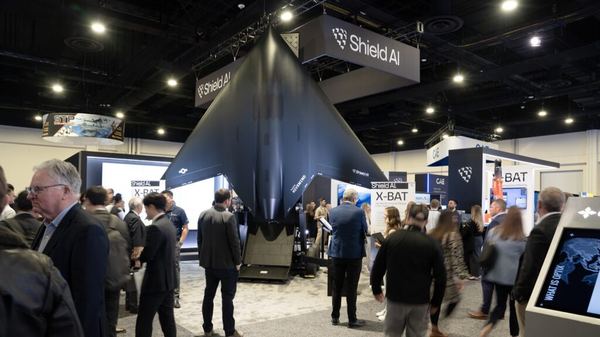
Shield AI chief executive Gary Steele said the acquisition dramatically accelerates the company’s efforts to meet growing customer demand for multi-mission capabilities, gives it increased access to a rapidly expanding counter-drone industry, and further diversifies its revenue. He described the company as now having three parts: autonomy software, autonomous systems and mission systems.
Of the $5.3 billion price, $4.8 billion will be paid at closing, with another $500 million paid if Echodyne meets specified performance targets. The deal is expected to close in early 2027. Echodyne will operate as a business unit inside Shield AI’s mission systems business, with Frankenberg staying on and reporting to Steele. There are no planned workforce reductions, and Echodyne employees will not be required to relocate.
Shield AI is not announcing any specific aircraft integrations yet, but a company spokesperson noted that autonomous aircraft will need more capable onboard sensors in the coming years, and that Echodyne’s radar is built for that use. The acquisition also adds radar engineering, manufacturing capacity and a commercial customer base to the business. The spokesperson added that the deal has no impact on the recent decision to work with RTX on a radar for the X-BAT, saying that work is separate. Coinciding with the deal, Shield AI raised $2.5 billion through Series H funding from Blackstone and JPMorgan Chase, and the spokesperson said the company will continue to look at acquisitions.
The deal shows the counter-drone market consolidating around full systems rather than single products. Radar, autonomy software and aircraft are merging into one company, and the $5.3 billion price says the market for drone detection and drone mitigation is now big enough to justify that kind of bet. For buyers, the direction is clear: the next generation of counter-UAS offerings will pair sensing and action in a single package, and the suppliers who own both halves will set the terms.
Source: Breaking Defense