
 العربية
 Português
 Русский
 Español
 English
 中文 (简体)
 اردو
 Türkçe
 فارسی
 हिन्दी
 Français
 Deutsch
 日本語
 한국어
 Afrikaans
 Shqip
 አማርኛ
 Հայերեն
 Azərbaycan dili
 Euskara
 Беларуская
 বাংলা
 Bosanski
 Български
 Català
 Cebuano
 Chichewa
 Corsu
 Hrvatski
 Čeština
 Dansk
 Nederlands
 Esperanto
 Eesti
 Filipino
 Suomi
 Frysk
 Galego
 ქართული
 Ελληνικά
 ગુજરાતી
 Kreyòl Ayisyen
 Hausa
 ʻŌlelo Hawaiʻi
 עברית
 Hmoob
 Magyar
 Íslenska
 Igbo
 Bahasa Indonesia
 Gaeilge
 Italiano
 Basa Jawa
 ಕನ್ನಡ
 Қазақша
 ខ្មែរ
 Kurdî
 Кыргызча
 ລາວ
 Latina
 Latviešu
 Lietuvių
 Lëtzebuergesch
 Македонски
 Malagasy
 Bahasa Melayu
 മലയാളം
 Malti
 Te Reo Māori
 मराठी
 Монгол
 မြန်မာ
 नेपाली
 Norsk
 پښتو
 Polski
 ਪੰਜਾਬੀ
 Română
 Gagana Samoa
 Gàidhlig
 Српски
 Sesotho
 Shona
 سنڌي
 සිංහල
 Slovenčina
 Slovenščina
 Soomaali
 Basa Sunda
 Kiswahili
 Svenska
 Тоҷикӣ
 தமிழ்
 తెలుగు
 ไทย
 Українська
 Oʻzbek
 Tiếng Việt
 Cymraeg
 isiXhosa
 ייִדיש
 Yorùbá
 isiZulu

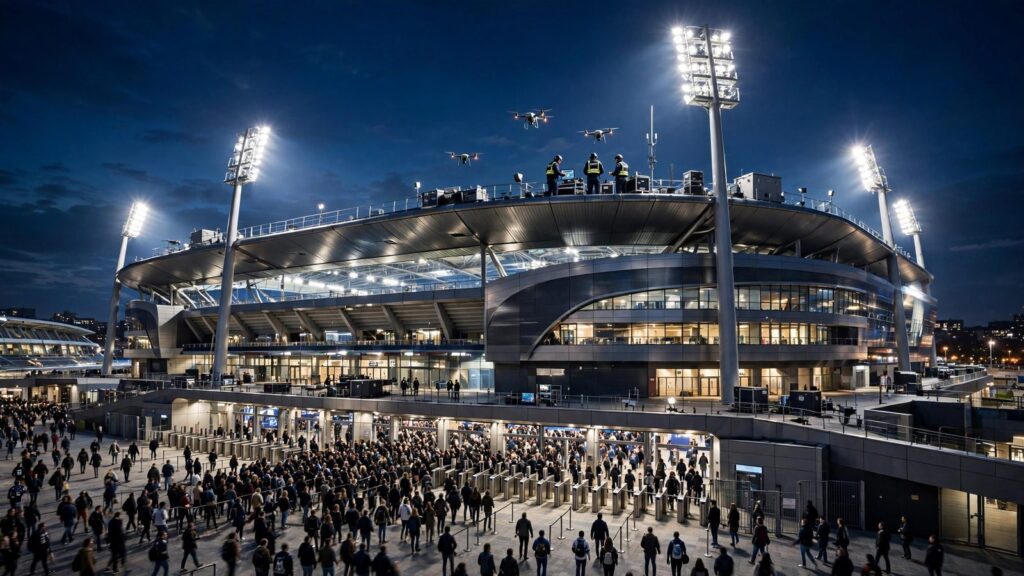
Short answer: A stadium needs portable detection for the roving teams, a fixed jammer for the airspace over the bowl, and a gun for the drone that gets through. The event lasts hours, the crowd is the target, and the threat is a small drone over the stands. Fixed systems guard the roof, handhelds guard the gates, and the gun stops the one that is already inside.
Why a stadium is different
A stadium is a fixed site for a few hours and an empty building the rest of the week. Fifty thousand people sit in one bowl, in the open, under a roof that is open to the sky. A drone over the stands is over the crowd, and a drone carrying anything is a threat to the crowd. There is no time to evacuate, and no way to put a roof over an open stadium.
The radio environment is also the worst a detector will meet: tens of thousands of phones on WiFi and mobile data, broadcast equipment, wireless cameras, and the stadium’s own systems. A detector that works on a quiet hilltop may struggle in a stadium bowl on match night. That is why the plan uses more than one tool, and why the tools are chosen for a noisy environment.
And the event is temporary. A permanent fixed installation for a site that hosts twenty events a year is hard to justify, but a purely portable setup leaves the roof unwatched. The answer is a small fixed core plus portable teams.
The three tools
1. The gun on the roof: DJSH-8B
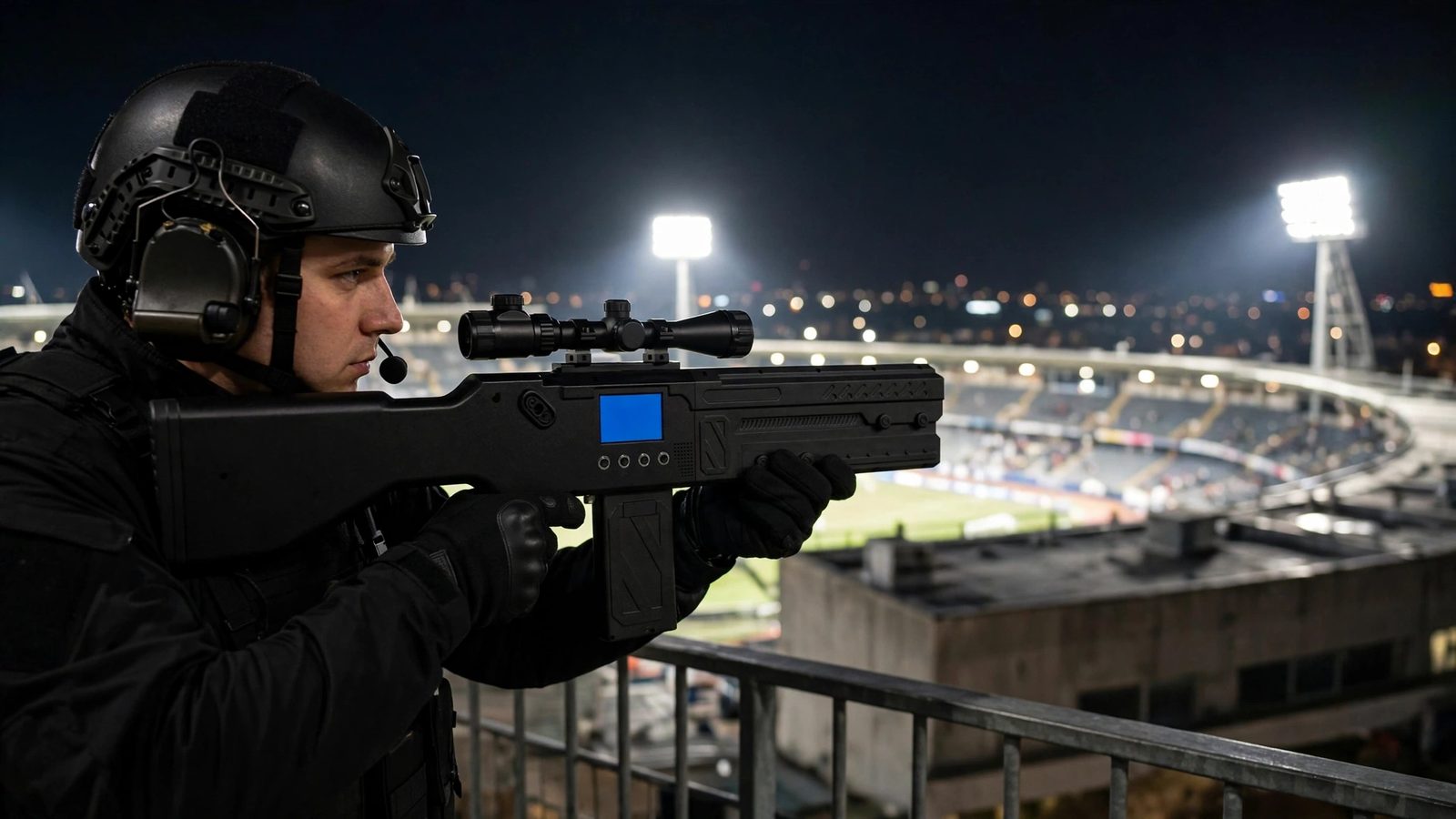
The APX-DJSH-8B is a handheld detection, jamming and spoofing gun. It detects across 300 MHz to 6.2 GHz at 1 km or more, jams on 8 bands at 180 W out to 800 to 1,500 metres, and adds GNSS spoofing with emergency landing and no-fly modes. It weighs 5.5 kg, is IP54 rated, and runs on a removable battery.
On a stadium, the gun goes to the roof team. The roof has the clearest view of the airspace over the bowl, and the gun’s operator can see the whole stadium from one position. When the fixed detector or a roving team reports a drone, the roof team has the range and the height to stop it before it reaches the stands.
2. Handheld detection at the gates: F13M
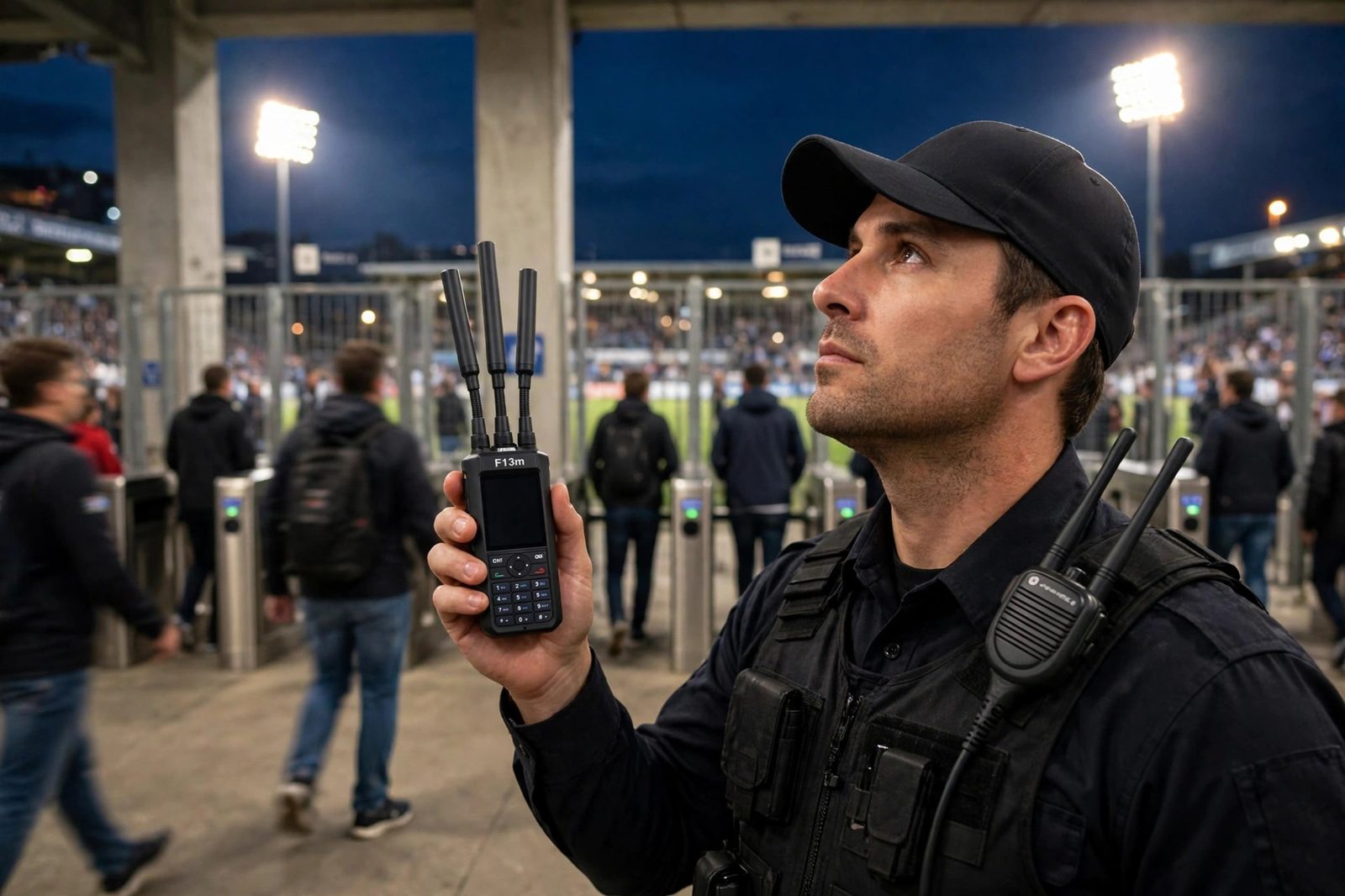
The F13M is a handheld detector that sweeps 300 MHz to 13.4 GHz in 1 MHz steps, identifies more than 100 drone types by signal signature, and detects out to 5 km. It weighs 0.45 kg, is IP54 rated, runs on a swappable battery, and shows the live spectrum, frequency, drone type and signal level on screen.
The F13M goes to the roving security teams at the gates and the perimeter. A drone is often launched from just outside the stadium, from a car park or a side street, and the team nearest the launch point is the one that will hear it first. A handheld that sweeps the full band to 13.4 GHz will hear it on whatever frequency it uses, and the operator can walk toward the signal to locate the pilot. Finding the pilot matters at a stadium: stopping the drone is one job, and finding the person flying it is the other.
3. Fixed jamming over the bowl: JF-8B
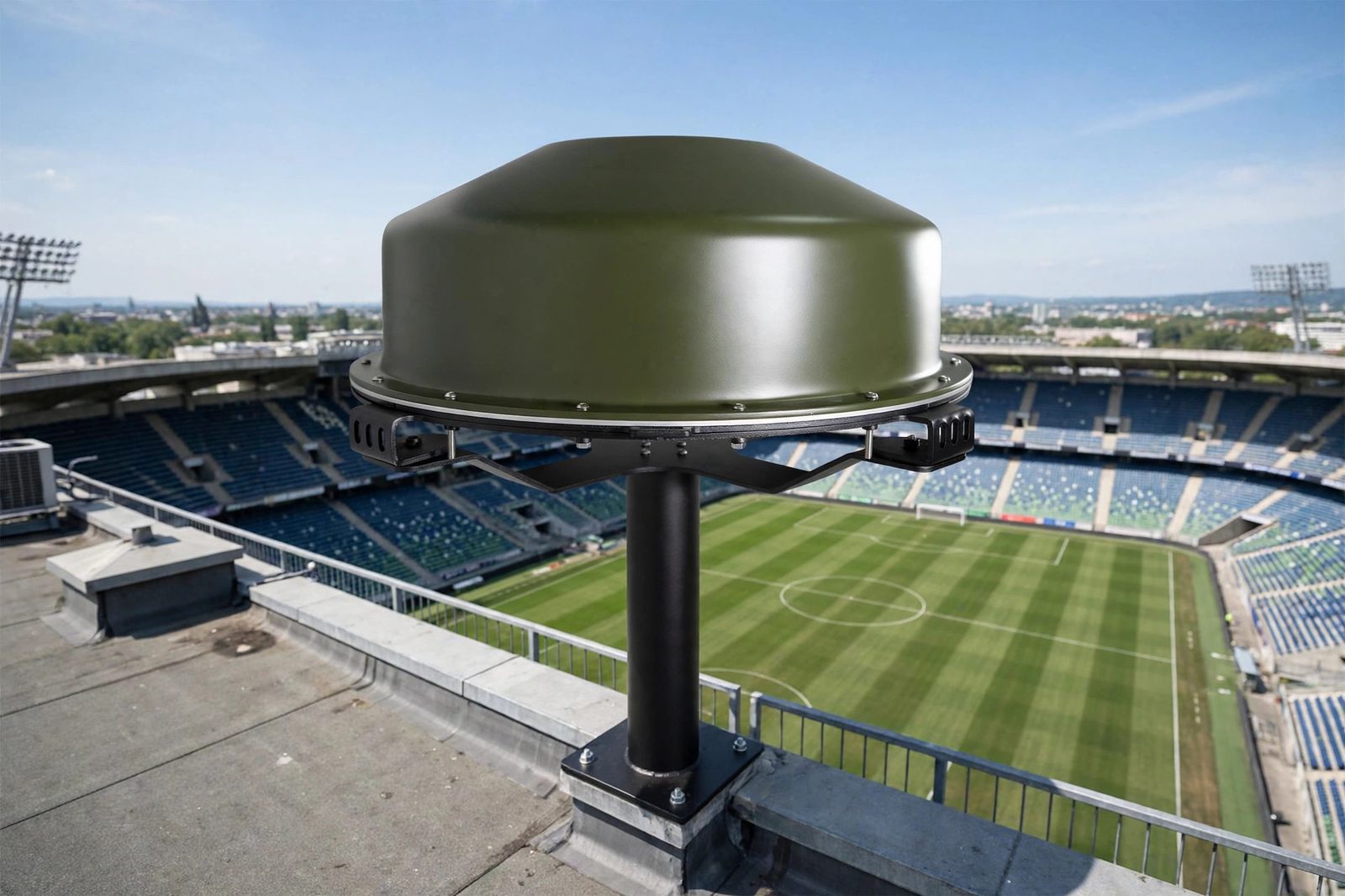
The APX-JF-8B is a fixed jammer. It covers 8 bands starting at 840 MHz, puts out 400 to 800 W in total, and jams up to 1 km omnidirectionally. It responds within 3 seconds, is IP65 rated, and weighs 16 to 20 kg.
The JF-8B is the fixed core: mounted on the stadium roof, it covers the airspace over the bowl to 1 km in every direction. One kilometre is enough for a stadium, because the bowl itself is smaller than that. The fixed jammer is always on, always in position, and does not depend on anyone running up the stairs with a gun. It is the layer that works while the roof team is still moving into position.
Comparison
| DJSH-8B | F13M | JF-8B | |
|---|---|---|---|
| Role | Handheld detection + jamming + spoofing | Handheld detection | Fixed jamming |
| Frequency | 300 MHz–6.2 GHz | 300 MHz–13.4 GHz | 8 bands, from 840 MHz |
| Detection range | ≥1 km | Up to 5 km | — |
| Jamming range | 800–1,500 m, 8 bands, 180 W | — | Up to 1 km, omni, 400–800 W |
| Spoofing | Yes, emergency landing + no-fly | No | No |
| Weight | 5.5 kg | 0.45 kg | 16–20 kg, fixed |
| Protection | IP54 | IP54 | IP65 |
| Best for | The roof team, stopping one drone | Roving teams, finding the pilot | The bowl, always on |
How the event runs
Before the gates open, the fixed JF-8B is on and the roof team is in position with the DJSH-8B. Roving teams with F13M units walk the perimeter and the car parks, sweeping the band. When a detector reports a drone, the roof team gets the direction, the nearest roving team moves toward the signal to find the pilot, and the gun or the fixed jammer stops the drone. The response is measured in seconds, because a drone over the stands does not give you minutes.
Two things to plan for. First, the radio environment: with fifty thousand phones in the bowl, set the detection thresholds for the event, not for a quiet test day. A detector tuned for a quiet site will alarm on everything in a stadium. Second, the rules: jamming and spoofing are for authorized use only. An event security team needs the authorization in place before the event, not during it.
FAQs
Is one jammer enough for a stadium?
One fixed JF-8B covers the bowl to 1 km, which is enough for the airspace over the stands. But a stadium also needs detection at the perimeter and a way to stop a drone that is already inside the bowl. That is why the plan has three tools: the fixed jammer for the bowl, the gun for the roof team, and handheld detectors for the roving teams. One jammer alone leaves the gates unwatched and the pilot unfound.
Can you find the pilot, not just the drone?
Yes, and at a stadium that matters. A handheld detector like the F13M shows the signal level as the operator moves, so the team can walk toward the strongest signal and find the pilot on the ground. Stopping the drone ends the immediate threat. Finding the pilot ends the event’s threat.
What if the event is a one-off, not a regular stadium?
The same three tools work, with the fixed jammer replaced by a second gun or a vehicle-mounted unit. A one-off event in a park or a square has no roof to mount a fixed jammer on, so the coverage comes from the teams: roving detectors to find the drone, and guns to stop it. The principle is the same — detect wide, confirm, and stop it before it reaches the crowd.